
A Brand is a Feeling

Several years ago I convinced our executive team that it was time for a brand refresh. The company’s customers, services and culture had changed dramatically since its founding four decades earlier–and its folksy logo and brand messaging didn’t reflect this transformational shift in the business.

Upon announcing the rebranding initiative at an all-company meeting, I came to quickly understand my enthusiasm was not shared by all. In fact, many employees–some of whom had been with the business for 30+ years, were vocally opposed to the idea. One such naysayer (we’ll call him Sam) approached me later that week to passionately to argue his case. “I just really believe replacing our logo is a terrible idea! Brands have value!”

To which I jumped up from my chair, threw my arms in the air, and excitedly replied, “Yes, I agree! Brands absolutely DO have value! But a brand is NOT a logo, Sam! A brand is a feeling!”

A brand is not a logo. A brand is a feeling. It’s the feeling someone gets
–customer, employee, the general public–whenever they hear or think about your company. That feeling comes with repeated experience, so it is built over time. It must be operationalized and is inseparable from company culture.
Hunh? A feeling?

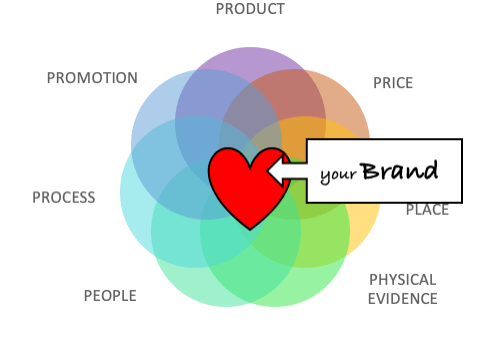
Don’t get me wrong–logos matter. They are part of an organization’s identity and physical evidence (to borrow from the “7P’s” of service marketing), and should reflect its personality–along with brand color palette, the style of other visual elements and the brand voice. But there is much, much more to a brand!

A BRAND results from the layering and interconnection of all the strategic decisions an organization makes–product/service value propositions, how customers are treated, what types of people get hired and promoted, how workflows pass from one functional area to the next, how technologies support or don’t support those workflows, where the capital investments are made. These mishmash of all these decisions produce the accumulated customer experience, employee experience, partner and public experience. So at its very essence, a brand is the result of the organizational values companies actually put into practice–which makes rebranding and brand-building difficult and complex work.

I asked Sam to think about how the business had changed since he first joined it. We had more than quadrupled in size, and the majority of our work was coming from a completely different industry. We’d invested heavily in facilities and laboratory instrumentation. We had created new positions to support a new way of serving customers. We had streamlined and formalized processes to improve efficiency, ensure quality, and deliver a consistent customer experience. We rewrote our employee handbook to remove outdated policies and signal trust in our people to make good decisions.

Sam nodded in agreement, “Okay. I get it. Can we at least have a say in what the new logo will look like. Maybe give employees a shot at designing it?”

“Hmmm.” I said, considering Sam’s request. I knew from experience that good logo design takes a special skill. But he clearly cared, and I wasn’t about to shut him down. Then it occurred to me…. Earlier in the day, the executive team had hammered out a draft of our new company mission and vision statements. But we had not started on the statement of values–the desirable behaviors and character traits on which the brand would be built.

I continued, “The new logo design needs to reflect our company’s personality. Would you be willing to co-chair a committee to write our organizational values?” I knew this request wasn’t exactly what Sam had in mind, but after a bit more explanation, he happily agreed.

Before leaving the office that evening, I sent an all-company email inviting anyone interested in talking about company values to join Sam and me for a brown bag lunch. To my surprise, our first values committee workshop filled the largest available conference room in the building. In the weeks that followed, teams came together to brainstorm, and to debate the nuances between meanings of words. They argued whether each truly characterized our company culture–or the one we wanted to create. And although the final list ended up longer than I’d hoped, I couldn’t have been more pleased with the outcome. Through this experience, I had raised a whole army of true brand ambassadors–front line employees who were proud of our organization and what we had become.

We decided our values included scientific excellence and exacting quality, and at the same time humility and commitment to service… we were trusted, intelligent problem-solvers. They also included persistence and hard work–we were midwesterners and our work ethic was a differentiator! We were on a very lean budget, so I knew the look and feel had to be bold.

In the end, I believe the creative succeeded in conveying our authentic. brand–while at the same time celebrating our people. Every layout featured an image of an employee’s face–tightly cropped from eyebrow to brim of nose–in laboratory safety goggles, smiling to add warmth. The result was a series of arresting visuals that caused one to look directly into each subject’s “intellectual eyes”–and had the added benefit of preserving employee anonymity. Many employees and customers made a game out of guessing the identities of those who were featured, which deepened the overall impact.

Nothing contributes so much to tranquilize the mind as a steady purpose – a point on which the soul may fix its intellectual eye.

Mary Wollstonecraft Shelley (August 30,1797 – February1, 1851)

We scheduled an all-company meeting offsite at a nearby convention center, so everyone could be together for the internal brand launch. I titled my presentation, “A Brand is a Feeling.” My goal was not just to roll out our new brand, but to recognize the solid work of the values committee and to impress upon every employee a responsibility to embrace the statement of values–as it was they, not the marketing team, who would build the brand. And “A Brand is a Feeling” stuck.

Not surprisingly, it also earned me years of friendly ribbing in hallways and meeting rooms. “How are you feeling today, Kristein?” Complaints were often aired in terms of feeling this way or that (usually with a smile).

I’ve since presented and re-purposed some version of that message over the years with other organizations, and every time it works. It resonates with people because, well, it’s true. It also urges employees (and hopefully their leaders) to think about marketing in broader terms–holistic terms.


What on earth is “holistic marketing”?

Holistic marketing is an approach to business motivated by the understanding that all elements of strategy are intimately interconnected–and that to build a great brand, marketing strategy must be applied to the inner-workings of the organization as a whole.

Since we now agree that a brand is a feeling, it follows that brand-building is not the ambit of marketing departments alone. It takes the whole tribe to build a brand: marketing, business development, sales, operations, technology–definitely operations and technology–and even finance and accounting have to be on board with strategy. If your brand essence implies (for example) speed, then every operational process and the technology that supports speed should be prioritized so that it will deliver that speed.

Consider the sad tale of an imaginary company that has recently developed a platform manufacturing process to enable rapid customization. With its new proprietary manufacturing line, this well-established manufacturer can now deliver a prototype in 24 hours and ramp up high volume production in a matter of days. This is big–disruptive even. Nobody in the industry even comes close. The leaders decide it’s time to modernize the company’s brand to fit its new charge. They file a DBA as “FlashCo,” redesign the logo to resemble Herme’s winged shoes and settle on a tagline, “Go for Speed.” The shiny new web site is beautiful. The brand launch attracts industry-wide attention, and in the first week, they get dozens of serious web inquiries. Then things go terribly wrong.

  • Although the new web site had been tested and accurately passing leads to CRM system, the company’s sales and marketing teams had different ideas about what constituted a qualified lead. Besides, CRM was cluttered with dated and duplicate records, and sales managers generally preferred to use spreadsheets to manage their territories. Needless to say, follow-up on web leads did not communicate speed.
  • Scoping and quoting custom projects had always been left to the company’s technical experts. These were problem-solvers, free thinkers who generally preferred his or her own approach to getting bids out the door. Swatting away salespeople nagging for proposals soon became sport.
  • Project handoffs to prototype engineers often lacked mechanical details–or the purchase orders required by Finance. This resulted in countless backtracking conversations with customers, expensive rework and unproductive finger-pointing.
  • Milestones were missed, but due to lack of systems integration, milestone invoices were automatically sent, irritating already unhappy customers. The Accounts Receivable team were trained in collections, not on how to resolve customer complaints. Conversations generally did not go well.

You get the picture. Although they had a great new strategy, FlashCo’s systems and business processes were not built to reliably deliver its brand promise. And very importantly, the company culture was not wired for speed. As a result, customers left unhappy, margins tanked and employee morale plummeted.

What went wrong? The leaders of FlashCo failed to examine their strategy holistically. They may have communicated “the WHAT” of their vision to the entire organization, but they probably forgot to explain “the How.” And clearly, they did not involve functional area managers in the plan, or require detailed operating plans to support their new brand promise.

Ugh. That’s depressing. I prefer stories with happier outcomes, don’t you? Stay tuned! In the next B2X blog, we’ll reintroduce “The Cycle of Happy” and illustrate how holistic marketing can turn your organization into a flywheel for success!

Until next time, I wish you good health and safety, the kindness of strangers, and the ability to greet each morning with gratitude.

Only My Very Best,
Kristein

A retrospective on “the blog” and why every business should have one

The term blog is short for weblog. It’s a kind of online journal–informal in tone, so the author (ah-hem, “blogger”) needn’t worry about perfectly polished prose. People who care about your blog’s message or theme may follow or share it, making it a great way to reach a lot of people with your ideas.

I was first introduced to blogs by my dear friend, Naomi, who started a travel diary to document her journey from her home in New Zealand to Cambodia in 2011. Her father had lost a long-fought battle with dementia, and her only child would soon be off to college. Feeling trapped in routine, Naomi’s yearning for adventure was matched only by a gnawing need to get away, to do something that felt important, life-changing. And because she is a nurse–and a person of most generous heart–choosing a destination for her meant deciding where in the world people most desperately needed help. A chance online search, a bargain airfare and a personal contact led her to an NGO in Cambodia. Friends and family questioned her sanity, but to Naomi, “It just felt right.” So after selling most of her possessions, she stuffed a single backpack with bare necessities, and boarded a one-way flight to Phnom Penh, where she planned to spend the next three months as a volunteer health care worker. (What came after those three months nobody knew, but Naomi assured us things would fall into place.)

Through her blog posts, Naomi gifted her followers with a lens into a world so different from our own. She reminded us of the unimaginable horrors Cambodians had suffered at the hands of Pol Pot and the Khmer Rouge regime 1974-79; in her patients, she witnessed the physical and psychological scars daily. She also shared joyful moments–like the surprise of seeing an elephant saunter down a busy street, and being offered a choice of free Coke or beer with her first fish pedicure courtesy of a tub bubbling with tiny Garra rufa. What began as a bold quest for self-rediscovery evolved into six years of soul-fulfilling work caring for an underserved community, mentoring local health care workers, and effectively changing the standard of medical care for all who she touched. Naomi said goodbye to her Cambodian colleagues in 2017, and has since started a new chapter of loving service–but that’s a topic I will save for another post.

Blogging for Business

Like most things internet-related, the “blog” has evolved, and its utility has greatly expanded in recent years. Although it’s still a practical way to stay close with family and close friends, a blog can now serve as a powerful platform for exchanging ideas with masses of people connected by common interests. When done with authentic intention, blogging is an effective way to share best business practices, convey your company culture, and connect with your customers. And (just like real life), if what you have to say is interesting and relevant, your audience will not only listen, they’ll share your blog with others. And voila! Before you know it, your blog will become an important part of your business’s marketing mix.

In my former corporate life, I advocated for business blogging, cajoling technical experts into sharing scientific insights as part of our company’s content marketing plan. Now that I’m working as an independent consultant, it’s time to put my preaching into practice. So here’s a sample of what you can expect from the B2X blog:

  • Thoughts on the importance of building a brand from the inside of a company out
  • My take on how technology can catapult sales and marketing efforts–or hasten a train wreck
  • Strategy vs. execution, and practical ways to keep them aligned
  • Stories from my professional life and the personal lessons I’ve learned
  • And like every other thing you read these days, probably some musings about living and working through a pandemic

Thank you for visiting the B2X blog. Until next time, I wish you good health and safety, the kindness of strangers, and the ability to greet each morning with gratitude.

Only My Very Best,
Kristein